Concrete Driveways, Slabs and Repair in Temple, TX

Twenty years of flatwork on Central Texas clay and shallow rock, with the drive approach permit pulled and posted before the pour.

Temple Elite Concrete is a concrete contractor serving Temple, TX, with 20+ years placing driveways, slabs and pads, patios, sidewalks, retaining walls, stamped and decorative concrete, resurfacing, leveling and commercial flatwork. We handle the whole job: the ground under it, the permit in front of it, and the finish on top of it. Most of what separates a driveway that lasts from one that cracks in three summers gets decided before the ready-mix truck arrives.

That is not a figure of speech here, because the soil map under this city splits almost in half. Roughly 41% of the mapped area is deep smectitic clay, counting Houston Black, Heiden, the Heiden-Ferris complex and Branyon, and Houston Black alone carries a plasticity index of 44 with a linear extensibility of 12%. Another 32% is shallow carbonatic soil over chalk, with paralithic bedrock at a representative 20 centimeters under Eddy. Two lots on one street can need two different slabs.

The other half of the job is paperwork most property owners never hear about until it stops them. A drive approach permit has to be issued before anyone removes or builds a curb, approach or gutter on public property, the city takes 10 business days to review an application, and an inspector then has one working day to approve or disapprove the prepared approach. We build every one of those waits into the schedule we hand you in writing.

Get Your Free Quote

Fast response • No obligation

So we can reach you about your request.

So we can send you a confirmation after you submit this inquiry form.

  • 20+ Years in Central Texas
  • Bonded & City Registered
  • Free Written Estimates

What we do

Our Services

Concrete Contractor Serving Temple and Bell County

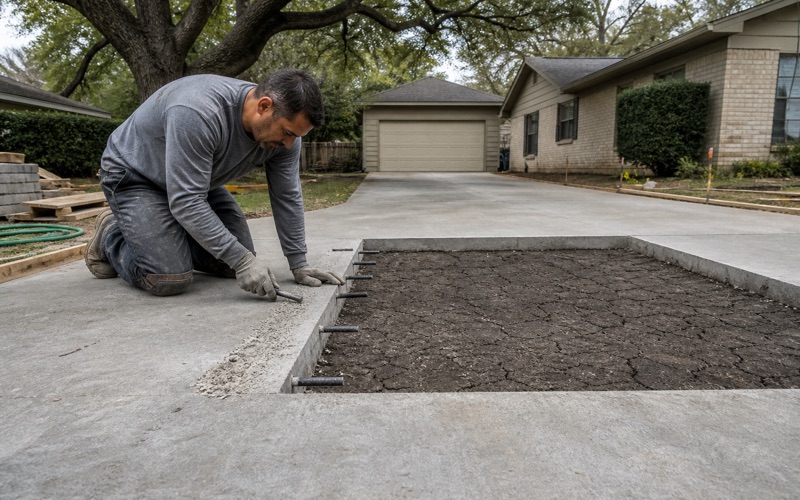
Dowel bars being set into the sawn edge of a sound driveway panel in Temple, the failed panel removed and the subgrade open below.

Concrete Repair

Slab leveling, crack and joint repair, grinding, panel replacement and bonded overlays for concrete in Temple, TX, quoted against replacement.

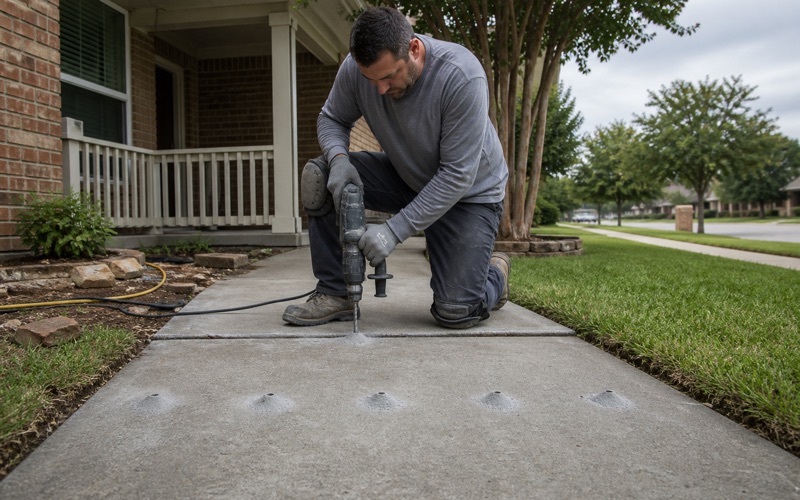
Injection ports being drilled across a settled front walk in Temple, a visible lip standing at the joint where one panel has dropped.

Concrete Leveling

Slab jacking for sunken driveways, patios, walkways and shop floors in Temple, TX, with an elevation survey and void map before any port is drilled.

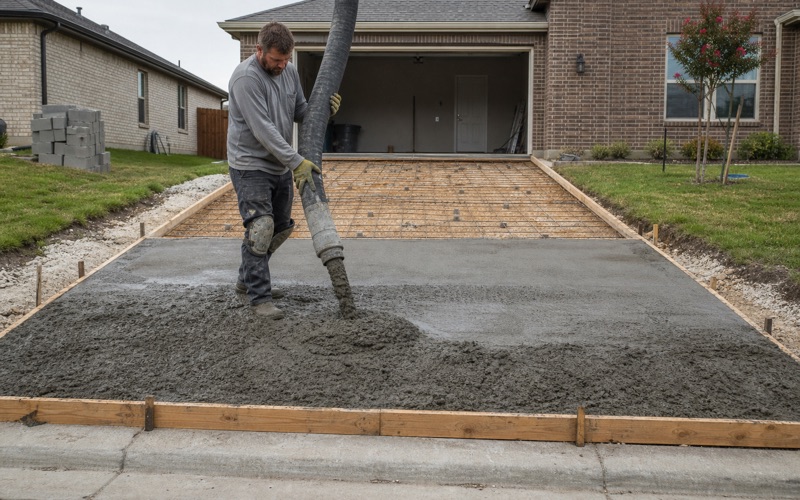
Ready mix being placed into formed driveway bays in Temple from a pump hose, the struck-off area behind and reinforcing on chairs ahead.

Concrete Driveway

New concrete driveways, aprons and drive approaches in Temple, TX, detailed to the soil under them and permitted through the city right-of-way.

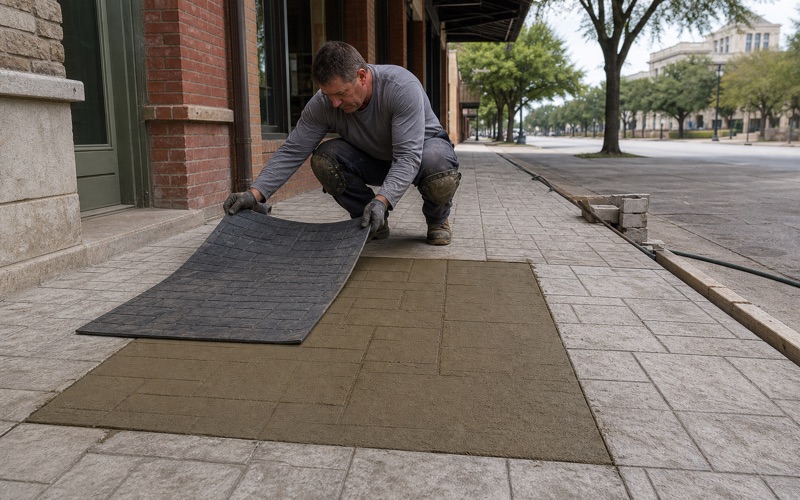
A texture mat being lowered onto a green sidewalk panel in downtown Temple so its pattern lines up with the cured stamped walk beside it.

Stamped Concrete

Stamped patios, driveways, walkways and pool decks in Temple, TX, with patterns and color systems chosen for sun exposure and clay movement.

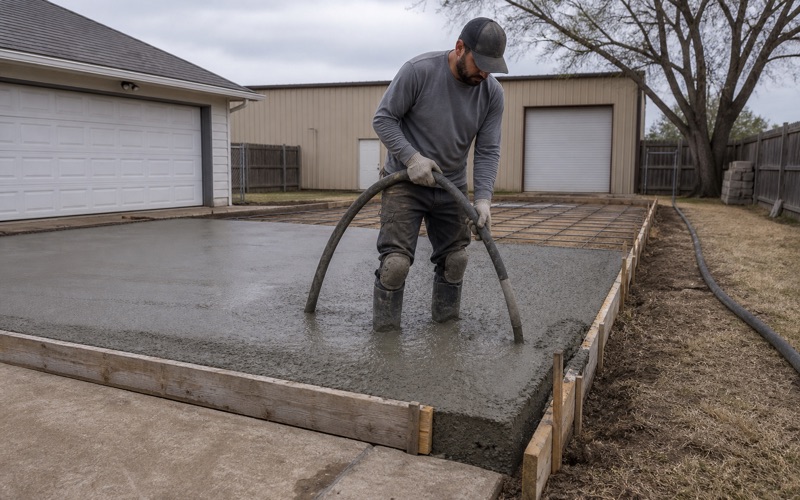
A shop pad being placed in Temple with a concrete vibrator worked down beside the thickened edge form, rebar still visible on the far half.

Concrete Slab

Shop floors, building pads, RV and equipment pads and commercial flatwork in Temple, TX, detailed for the load and the soil beneath them.

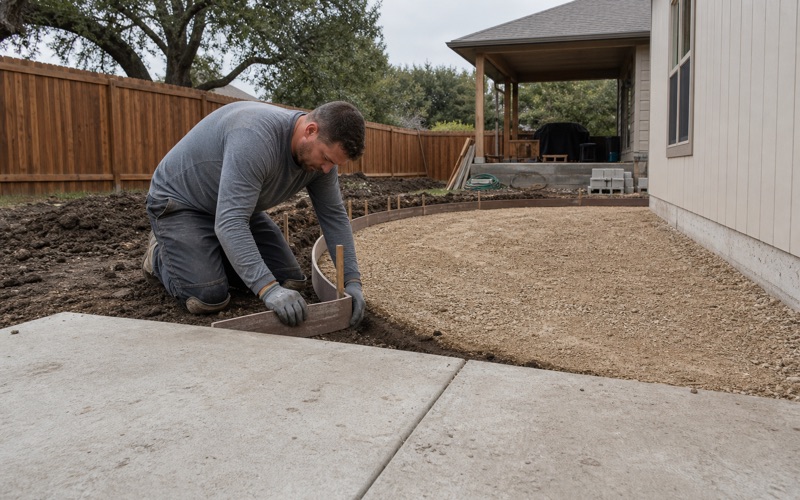
A curved patio being formed in Temple with flexible form board bent to the radius, the base course and turndown trench inside it.

Concrete Patio

New concrete patios, extensions and resurfacing in Temple, TX, laid out for real furniture and detailed so water leaves the house.

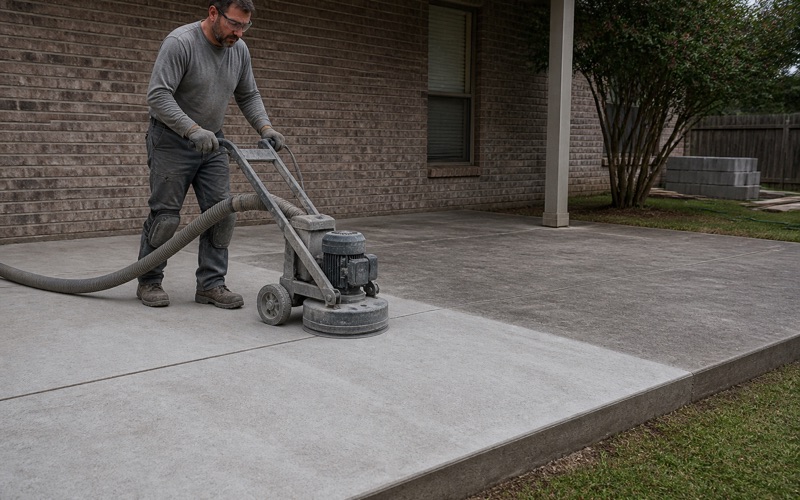
A weathered patio slab in Temple being profiled with a walk-behind grinder, the ground pale half meeting the untouched half in a straight line.

Concrete Resurfacing

Microtoppings, spray texture and stamped overlays for sound concrete in Temple, TX, restoring the surface without demolition.

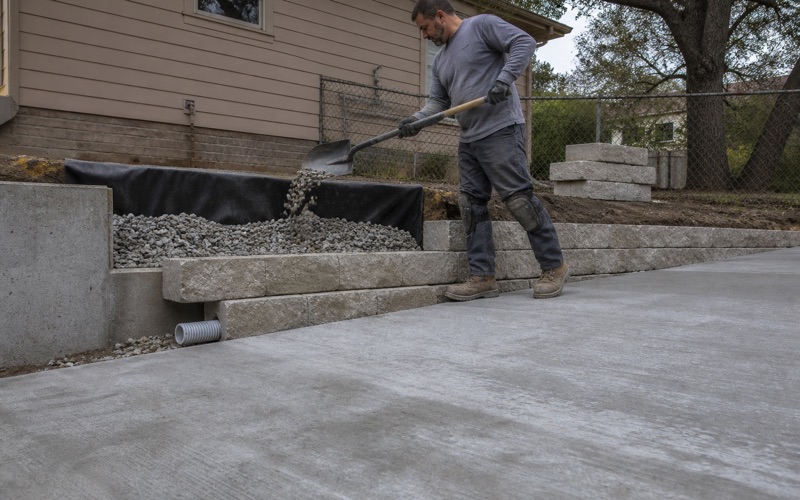
Drainage stone being shoveled in behind a part-built block retaining wall in Temple, filter fabric up the back and an outlet pipe at the low end.

Concrete Retaining Wall

Poured concrete and segmental retaining walls in Temple, TX, engineered around drainage, footing bearing and the soil pushing on them.

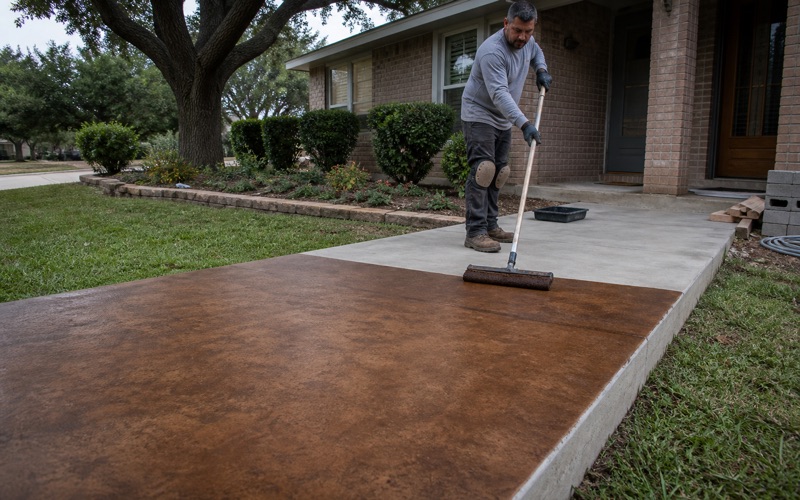
Acid stain being drawn across a cured entry landing in Temple with a long-handled applicator, the stained half meeting the pale bare half.

Decorative Concrete

Color, texture, stain, overlays, engraving and polished finishes for new and existing concrete in Temple, TX.

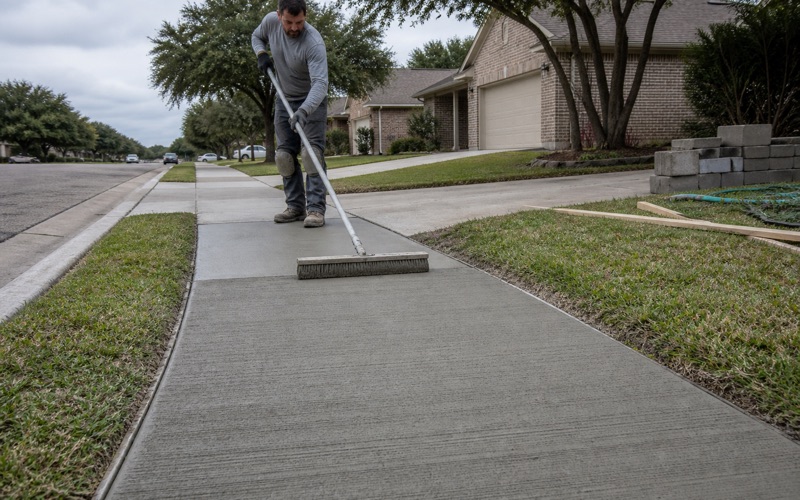
A replaced public sidewalk panel in Temple being broom finished to match the cured panels each side, at the same width as before.

Concrete Sidewalk

Public sidewalk replacement, curb ramps and private walkways in Temple, TX, built to the width and grade the code requires.

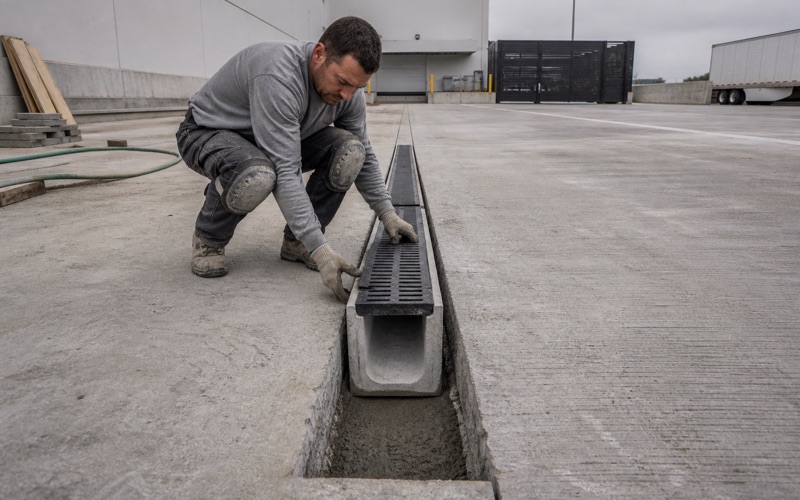
A trench drain channel being set into a formed slot across a commercial drive lane in Temple, with a loading dock apron beyond.

Commercial Concrete Contractor

Parking lots, curb and gutter, islands, loading areas and drive approaches for commercial sites in Temple, TX, checked against the code before forming.

What Makes Temple Elite Concrete Accountable Here

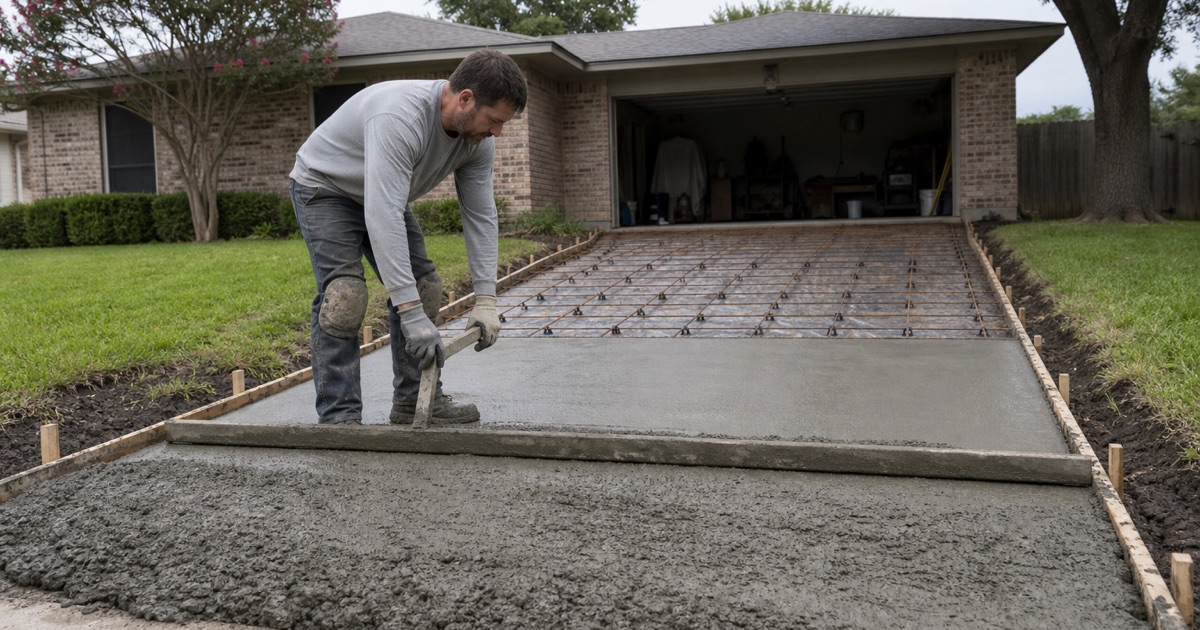
A residential driveway pour in Temple being struck off with a screed board between the forms, the flat surface running back toward the garage.

20+ Years of Concrete Work

Two decades of flatwork in this market is mostly a record of which subgrades behave and which do not. We have poured on Houston Black that moves with every wet and dry cycle and on Purves with lithic bedrock at a representative 36 centimeters, and that difference shows up in how a job is priced rather than in how it is sold.

Registration and Bonds You Can Check

Texas issues no state license for concrete contractors, so the credential worth verifying is local. The city’s annual contractor registration, the bond required before working in streets or public ways, and the separate drive approach bond are the only paperwork a property owner can actually confirm, and ours are current.

A Full Year on Right-of-Way Work

A contractor has to keep a drive approach free from structural defects for one year from the date of final approval and acceptance by the city, at no cost to the owner. We stand behind that whole year rather than treating final payment as the end of the relationship.

Why Choose Temple Elite Concrete

Subgrade Checked Before the Quote

Every quote starts with what the slab will sit on, because a lot straddling Houston Black clay at a plasticity index of 44 and Austin silty clay at 37 behaves as two subgrades under one pour, so thickness, reinforcement and control joint spacing get sized to the ground rather than copied off the last driveway one street over.

Rock Priced Before the Machine Moves

No excavation number reaches our proposal before we know the likely depth to refusal, since paralithic bedrock sits at a representative 20 centimeters under Eddy soils and 74 centimeters under Austin, so rock excavation is in the original price rather than arriving as a change order the morning the bucket stops digging.

Drive Approach Permit Pulled and Posted

We pull the drive approach permit ourselves and display it on site, because Code Section 32-116 makes it unlawful to pour concrete or begin any approach without the approved permit posted, so your job is never shut down mid-pour rather than gambling that no inspector drives past.

Washout Contained on Site

Never does a truck on our job rinse toward a storm drain. Discharging ready-mixed concrete or wastewater from cleaning equipment into the city storm sewer is an offense under Code Section 27-43, so containment travels with the pour rather than turning your address into the one on the citation.

Summer Pours Scheduled Around Heat

Placements get scheduled against the temperature of the concrete rather than the calendar, because once the mix reaches 90 degrees the state highway standard allows 45 minutes from batching to begin discharging, or 75 minutes with a Type B or D admixture, so loads are sized to what the crew can finish rather than left to stiffen in the chute.

Repair Quoted Against Replacement

Every sunken or cracked slab gets both numbers, what it costs to lift and repair and what it costs to demolish and repour, because leveling an existing slab usually lands well under a replacement, so the choice is made on real figures rather than on whichever option the contractor would rather sell.

New Concrete, and the Ground It Goes On

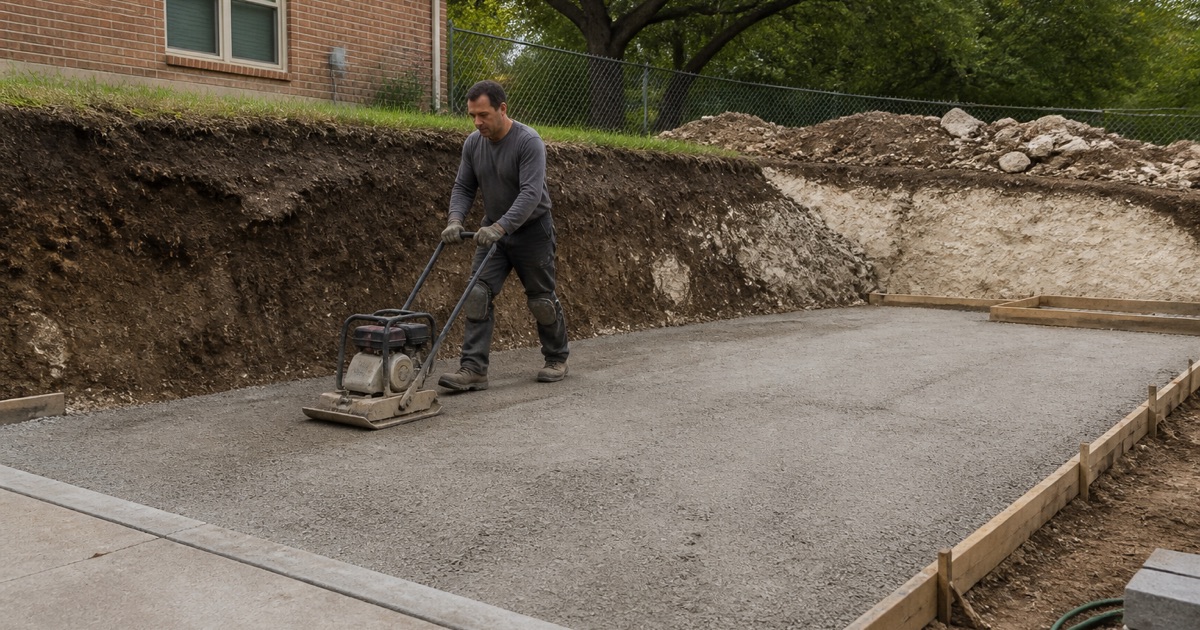
A slab excavation in Temple whose cut face shows deep dark clay at one end and pale chalk at the other, with base course being compacted between the forms.

What a Concrete Driveway Job Involves, Start to Finish

Flatwork runs in a fixed order: a read on the soil and likely depth to refusal, the permit application, excavation and subgrade compaction, base course, forms, reinforcement, the pour, the finish, then curing. We hand you that sequence with dates attached, including the 10 business days the city takes to review a permit and the 4:00 p.m. cutoff for a next-business-day inspection. Knowing where the waiting sits keeps a two-week job from feeling stalled.

Expansive Clay Subgrade Under a New Slab

Roughly 41% of the mapped soil under the city is deep smectitic Vertisol, and Houston Black is 54% clay in the surface horizon with a linear extensibility of 12%. That ground swells and shrinks with moisture, and a slab poured over it without compaction, adequate thickness and a deliberate joint plan simply moves with it. A quote that talks only about psi is telling you very little.

Houston Black, Austin and the Shallow Chalk Soils

About 27.2% of the city sits on Houston Black clay and its urban-land complex, while another 32% is shallow carbonatic soil over chalk, with Austin at about 19.3%, Stephen at about 6.4% and Purves at about 4.2%. Houston Black carries a plasticity index of 44 against Austin’s 37, and both exceed the plasticity index of 15 that triggers the expansive-soil provisions of IRC Section R403.1.8.1. We establish which one your address falls on before pricing.

Concrete Driveways and the City Approach

A residential driveway is two jobs wearing one surface: the private portion on your lot, and the drive approach where it crosses into right-of-way and ties into curb and gutter. The approach is the regulated half, carrying a minimum corner clearance of 15 feet, a minimum curb return radius of two and one-half feet, and a bar on new residential approaches onto an arterial unless the lot was platted fronting it.

Drive Approach Permits, Bonds and the Pre-Pour Inspection

Before any curb, approach or gutter on public property is removed or constructed, the city wants an approach permit displayed on site, a $1,000 bond under Code Section 32-119 for drive approach construction, and a $3,000 bond under Section 32-32 for work in streets and public ways. Once the approach is formed we notify the inspections department and wait, because the inspector has one working day to approve or disapprove it.

Concrete Slabs and Pads for Shops, Sheds and RV Parking

Shop floors, shed pads, RV aprons and equipment bases are point-load problems rather than surface problems, so each gets its own thickness, welded wire reinforcement or rebar layout, and control joint spacing, commonly 24 to 36 times the slab thickness. We ask what will park or sit on the pad first, including whether an electrician needs a concrete encased electrode, the Ufer ground, tied in before the pour.

Summer Concrete Placement and the Discharge Clock

Ready-mix arrives on a clock and heat shortens it: once the concrete reaches 90 degrees the state highway standard allows 45 minutes from batching to begin discharging, or 75 minutes with a Type B or D admixture. In a stretch running 101 to 103 degrees with overnight lows of 76 to 77, there is no cool window to shift a pour into. We size loads and staff the finish accordingly.

Curing Time Before Foot Traffic, Vehicles and Sealer

Concrete gains strength on a curve rather than a switch, and the 28-day compressive strength everyone quotes is a test age, not a waiting period. We give you three separate dates at the pour: when you can walk on it, when a passenger vehicle can park on it, and when a penetrating or film-forming sealer can go down. Those dates move with the weather and the mix.

When Concrete Cracks, Sinks or Lifts

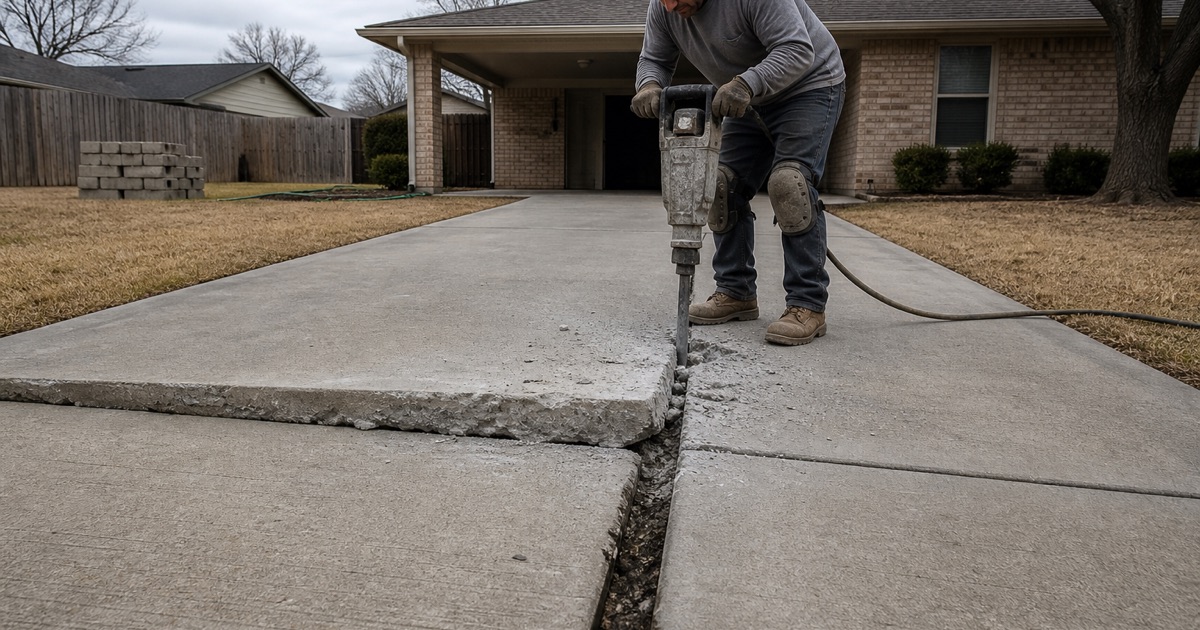
A heaved driveway panel in Temple being chipped along a straight break line with a hydraulic breaker, dark cracking clay open in the joint below.

Why a Concrete Driveway Sinks

A sinking slab is almost never a concrete problem; it is a support problem. On smectitic clay the subgrade shrinks away during a dry stretch and leaves a void, and water then finds the void and enlarges it. We probe and inspect before quoting, because the repair that fills a void and the repair that rebuilds an unstable base are not the same repair.

Structural Cracks Against Shrinkage Cracks

Hairline cracks that follow the sawcut pattern, stay tight and show no elevation difference are normal curing behavior, worth caulking rather than replacing. Cracks that keep widening, run diagonally across a panel, or leave one side higher than the other are telling you the ground underneath moved. We put in writing which one you have, including when the honest answer is that nothing needs doing.

Polyurethane Foam Lifting Against Mudjacking

Both methods raise a settled slab by injecting material through drilled holes instead of replacing it. Mudjacking pumps a cement slurry through larger holes and adds real weight to the soil that already gave way; polyurethane foam goes through much smaller holes, expands in place, weighs a fraction as much and takes traffic the same day. On expansive clay that weight difference is the argument.

Grinding a Lifted Sidewalk Panel

When a root or a heaving panel leaves one sidewalk section standing proud of its neighbor, the fix is often a grinder rather than a saw and a dump truck. Grinding takes the lip down to a walkable transition in an afternoon, at a fraction of replacement cost, leaving the panel and its joints intact. It is the smallest invoice on the page, which is why we quote it first when it works.

Trip Hazards and Public Sidewalk Liability

Code Section 32-10 forbids damaging, demolishing or removing a serviceable public sidewalk without rebuilding it to city specifications, and without narrowing or regrading it in the process. That makes an abandoned half-repair a code problem stacked on a trip hazard. We walk the run, name the panels genuinely out of tolerance, and put the sidewalk back at the width and grade it already had.

Concrete Repair Against Full Replacement

Leveling, grinding and partial panel replacement usually land well under demolition and a new pour, and on a slab whose concrete is still sound they buy years. Replacement wins where a panel is cracked through in several directions, where the surface has lost its top layer across a wide area, or where the base has to be rebuilt anyway. You get both numbers with the reasoning behind each.

Patching Over an Unsupported Slab

A patch bonds to concrete; it does not bond to air. Filling a crack on a panel that has lost its support underneath produces a repair that looks finished and reopens along the same line within a season, because the slab is still free to flex over the void. We fill the void first, by injection or by rebuilding the base, and treat the surface repair as the last step.

Spalling, Scaling and Surface Breakdown

Spalling is concrete flaking away in patches, usually where reinforcement sits too shallow or the surface was worked while bleed water was still on it; scaling is the top layer peeling off in sheets. Both are failures of the surface layer, which is why resurfacing over sound concrete often solves them and a full tear-out often is not necessary. We check the substrate before recommending either.

Decorative Concrete and Finishes

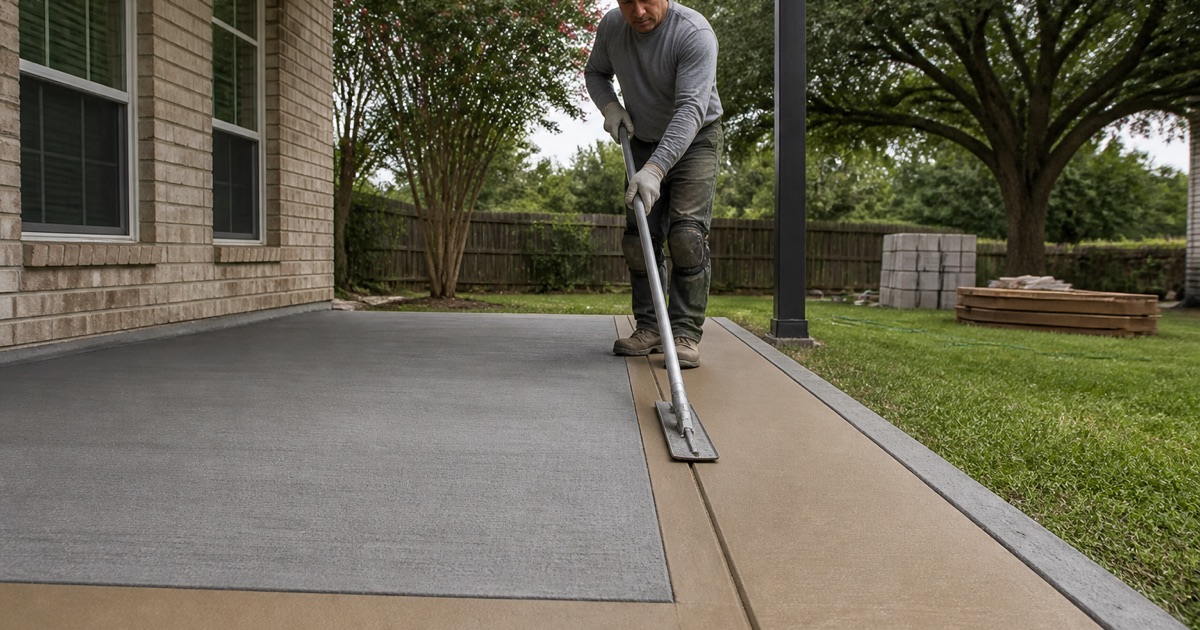
A tooled border being run between a colored band and a broom finished field on a green patio in Temple, the straight joint line dividing the two.

Stamped Concrete Patterns for Central Texas Homes

Stamped concrete presses a texture and joint pattern into fresh concrete with mats and a release agent, so a single pour reads as stone, brick, slate or plank. Ashlar slate, seamless stone and running bond brick sit comfortably against the limestone and brick elevations common on houses here, while heavily grouted cobble patterns tend to fight them. We lay the pattern out against your elevation before the pour.

Integral Color, Dry Shake Hardener, Stain and Dye

Integral color is mixed through the whole load, so a chip shows the same color underneath, though it costs the most and limits how deep a shade you can reach. Dry shake hardener is broadcast onto the fresh surface and densifies it while it colors. Acid stain reacts chemically for a translucent, variegated result, while dye is more vivid and less stable in sun.

Exposed Aggregate Concrete Finishes

Exposed aggregate washes or grinds the top layer of paste away to reveal the stone in the mix, which is why plenty of people describe the look before they know its name. It delivers slip resistance without a coating and hides staining better than a smooth surface, and the result depends entirely on the aggregate gradation in the load. We show you the rock the plant is supplying first.

Broom, Salt, Float and Trowel Finishes

A broom finish drags texture across the surface for outdoor traction and is the sensible default on driveways and walks. A salt finish presses rock salt in and washes it out for a pitted texture; a float finish leaves an open, matte surface; a steel trowel finish closes it hard and smooth, which belongs indoors and is dangerous wet. We choose from where the slab sits, not from a sample board.

Stamped Concrete, Pavers and Flagstone Compared

Pavers and flagstone are individually set units with joints that can be re-leveled and weeds that come through them; stamped concrete is one monolithic slab that will not shift unit by unit but will crack where the ground tells it to. On expansive clay a monolithic slab with a deliberate joint plan usually stays flatter, while set units are easier to lift for a utility.

Concrete Sealers, Sheen and Realistic Resealing

Penetrating silane and siloxane sealers soak in and leave the surface looking unchanged; film-forming acrylics sit on top, deepen the color and add sheen, and they are the ones that eventually need renewing. Sheen runs from matte through satin to wet-look, and the higher the gloss the more visible its wear becomes. A film-forming sealer on a driveway here is a recurring maintenance item.

Resurfacing and Overlays on Sound Concrete

A microtopping or stamped overlay bonds a thin polymer-modified layer over existing concrete, so a worn but structurally sound driveway or patio can take a new surface and pattern without demolition. It is not a repair for a slab that is still moving, since an overlay over an active crack telegraphs it straight back through. We test the substrate for soundness and bond before quoting one.

Decorative Concrete Cost Against Plain Flatwork

Decorative work carries the same excavation, base and reinforcement as a plain slab, so the added cost sits almost entirely in the finish: stamping labor, color, release agent and sealing. That is why a stamped patio and a broom-finished patio of the same size land closer together than most people expect, and why the gap widens on small pours where setup dominates.

Commercial, Code and Accessibility Work

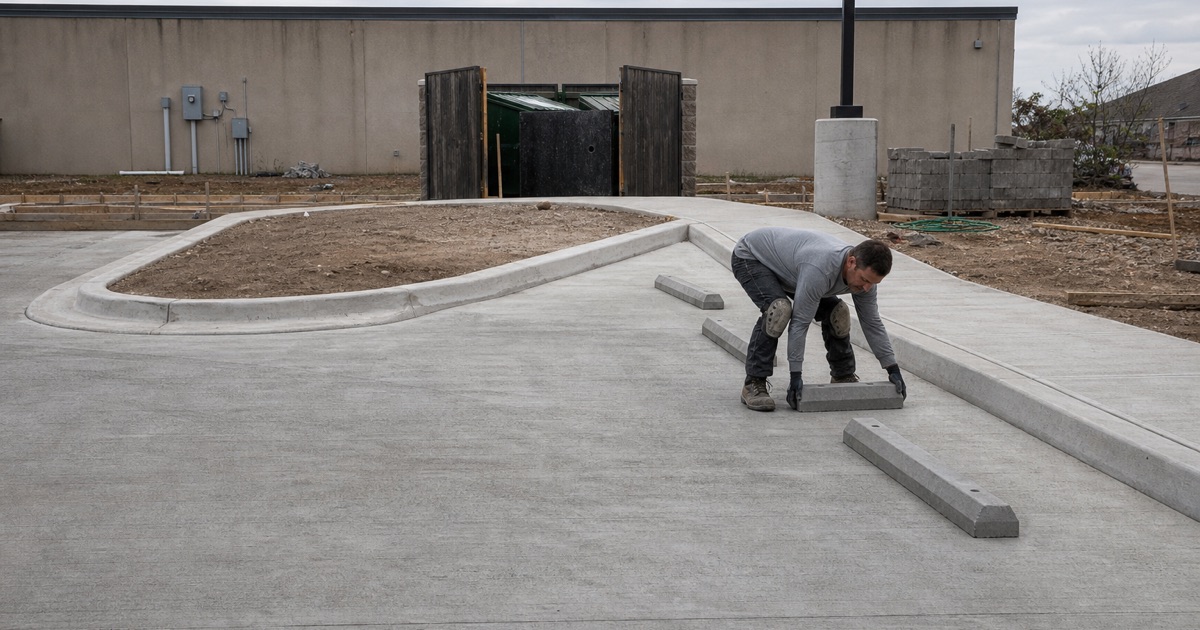
A precast wheel stop being set beside a raised walk at a Temple parking lot, with six inch curb and gutter formed around a landscaped island.

Commercial Parking Lot Paving and Perimeter Curb

The Unified Development Code requires all parking areas to be paved with asphalt or concrete, with curb and gutter six inches in height around the perimeter of the parking area and around all landscaped parking islands. That curb is not trim; the drainage design and the pavement edge both depend on it. We build the perimeter, the islands and the connecting driveway as one system.

Landscaped and Terminal Islands in the I-35 Corridor Overlay

In the I-35 Corridor Overlay, interior landscaped parking islands must be a minimum of 170 square feet and 10 feet wide back-of-curb to back-of-curb, with an allowance for a 2-foot strip of additional concrete, stone or pavers, and terminal islands a minimum of 360 square feet. Wheel stops are required adjacent to all sidewalks except raised sidewalks at least 6 feet wide, or 8 feet where parking fronts both sides.

Loading Berths, Truck Courts and Dumpster Pads

Off-street loading areas have to be paved with asphalt or concrete, and each berth must be a minimum of 10 feet by 45 feet, which is the governing dimension behind most dock aprons and truck courts. Dumpster pads take concentrated wheel loads on a small footprint and are where thin commercial flatwork fails first. We thicken and reinforce those areas rather than running one thickness sitewide.

Commercial and Industrial Drive Approaches

Commercial two-way curb cuts run from a minimum of 24 feet to a maximum of 45 feet with a minimum edge clearance of 5 feet, while industrial two-way curb cuts run from 35 feet to 50 feet with curb return radii of 15 to 50 feet. Total curb cut may not exceed 50 percent of lot frontage, and an approach may meet a two-way roadway at an angle between 45 and 90 degrees.

Curb Ramps and Detectable Warning Surfaces

An accessible route is only as good as its worst panel, and the ramp running slope, the landing at the top, the flare grades at the sides and the detectable warning surface at the bottom all have to work together. We form ramps and set truncated dome panels as part of the flatwork rather than as an afterthought. Getting one of those four wrong turns a finished walk into a rebuild.

Downtown Sidewalk Replacement and Pattern Matching

In the Central Area district, new sidewalk width is the greater of the adjacent width, the predominant block width, the existing right-of-way width, or 6 feet, and a repaired or replaced sidewalk must go back at its previous width with any decorative pavers or stamped patterns repaired or replaced. We photograph and template the existing pattern before demolition so what goes back reads as the same sidewalk.

Right-of-Way Work, the Bond and the One Year Warranty

Work in the right-of-way carries obligations that outlast the final invoice. A contractor must keep a drive approach free from structural defects for one year from the date of final approval and acceptance by the city, at no cost to the owner, and defective work must be corrected by the contractor or the bondsman. A contractor without the bond leaves the property owner holding that problem.

Washout Containment and Slurry Control

Discharging ready-mixed concrete, mortar, or wastewater from cleaning the equipment used to transport or apply it into the city’s storm sewer is an offense under Code Section 27-43, as is a harmful quantity of dust from sanding, grinding, cutting or sawing. Site work of one acre or more falls under the city’s small construction activity definition and five acres or more under large construction activity.

Areas We Serve

Temple Elite Concrete provides concrete-contractor throughout the greater Temple area, with the same crews and the same standards on every job.

Good to know

Frequently Asked Questions

How much does concrete work cost in Temple, TX?

Price follows square footage, thickness, reinforcement and what the excavator hits. A flat lot on deep clay and a lot with bedrock a foot down are different jobs at the same square footage, because rock excavation is labor rather than material. Permits, the approach bond where work crosses right-of-way, and any decorative finish are separate lines on one written proposal.

Do I need a permit to pour a driveway in Temple?

Yes. The city charges $35 for a flatwork, driveway or paving permit and $35 for an approach permit, and a drive approach permit must be issued before anyone removes, alters or constructs a curb, approach or gutter on public property. Applications get 10 business days for city review and comment, and no work may start before approval.

Are concrete contractors licensed in Texas?

Texas issues no state license for concrete contractors, which is why the question is worth asking carefully. What can be checked locally is the city's annual contractor registration, currently $80, plus the bond required before working in streets or public ways and the separate drive approach bond. Those three are the only credentials a property owner can actually verify.

How long does a concrete project take from first call to finished slab?

The concrete itself is usually the shortest part. Budget 10 business days for the city to review a permit application, then excavation, base and forming, then one working day for an inspector to approve a prepared approach after we call it in. Requests placed after 4:00 p.m. move to the following business day.

How do you decide the thickness and reinforcement for my slab?

From what the slab sits on and what will sit on the slab. Houston Black clay at a plasticity index of 44 and Austin silty clay at 37 behave differently under the same load, and both exceed the plasticity index of 15 that triggers the expansive-soil provisions of IRC Section R403.1.8.1. Point loads from an RV or a press change the answer again.

Is it cheaper to level and repair concrete than to replace it?

Usually, and by enough that it decides most jobs. Lifting a settled slab, grinding a raised panel or replacing a single panel typically lands well under demolition and a new pour, provided the concrete itself is still sound. Replacement makes sense once a panel is cracked through in several directions or the base has to be rebuilt anyway.

Can concrete be poured during a Central Texas summer?

It can, but the schedule has to respect the clock. Once the concrete reaches 90 degrees the state highway standard allows 45 minutes from batching to begin discharging, or 75 minutes with a Type B or D admixture, and an overnight low of 76 to 77 degrees leaves no cool window to move into. We start early and staff the finish.

When can I walk on, drive on and seal new concrete?

Those are three different dates, not one. Concrete gains strength on a curve, and the 28-day compressive strength quoted on specifications is a test age rather than a waiting period. Foot traffic comes first, vehicle parking later, and sealing later still, with all three shifting depending on the mix and that week's weather.

What happens if concrete work is done without the required permit?

The city charges $50 for working without a permit and doubles the permit fees on top of it, and Code Section 32-116 makes it unlawful to pour concrete or begin a drive approach without the approved permit displayed on site. The larger exposure is the work: an approach poured without the pre-pour inspection can be required to come out.

What warranty comes with work in the city right-of-way?

A drive approach must be kept free from structural defects for one year from the date of final approval and acceptance by the city, at no cost to the owner, and defective work has to be corrected by the contractor or the bondsman. We carry both the street and public way bond and the drive approach bond.

Ready to Get Started?

Request a free quote today and we'll get back to you fast.