
Temple Elite Concrete provides concrete leveling in Temple, TX, serving surrounding cities including Belton, Nolanville, Harker Heights, Killeen and McGregor, and 20+ years on this ground is mostly what the service is worth paying for. Lifting a slab is a straightforward mechanical act. Knowing whether the ground under it will hold the new elevation, and for how long, is the part that separates a fix from a postponement.
Leveling exists because concrete rarely fails on its own. A panel that has dropped an inch is usually undamaged concrete resting on ground that gave way underneath it, and tearing it out replaces the only sound component in the assembly. Filling the space and bringing the slab back to grade costs a fraction of that and takes a fraction of the time, without a single load of demolition leaving the property.
What makes the decision local is the ground itself. Houston Black clay carries a plasticity index of 44 and a linear extensibility of 12%, so it genuinely withdraws from beneath a slab through a dry stretch and swells back afterward. On the chalk side of the city, shallow soils sit over paralithic bedrock at a representative 20 centimeters under Eddy, so a slab can be supported at one end and hanging over compressible material at the other.
Why Concrete Sinks on Central Texas Ground
Clay Shrinkage and the Voids It Leaves
Smectitic clay changes volume with moisture rather than with load. Through a dry summer it pulls back from the underside of a slab, and the slab, being rigid, does not follow it down evenly. What you get is a panel bridging an air gap, holding until a vehicle or a rainfall event puts enough load on it to snap it down.
The rebound matters too. When the clay takes water back on it swells, which is why a driveway can sink one year and heave a lip the next without anything having been done to it. Leveling on that ground is about restoring support across the whole panel, not about winning an argument with a soil that will keep moving.
Poorly Compacted Fill and Utility Trenches
The other common cause has nothing to do with clay. Backfill over a water, sewer or conduit trench that was never brought to density keeps consolidating for years, and the slab above it settles in a strip that follows the trench line. Sidewalk panels crossing a service line and driveway sections over a sewer lateral are where this shows up first.
This one is easy to identify and easy to misdiagnose, because a trench settlement looks identical to a clay void from above. The difference is the shape: consolidation follows a straight line across the slab, while a clay void spreads irregularly from wherever the soil dried hardest. Reading which pattern is in front of us decides how much material the lift needs.
Water From Downspouts, Irrigation and Sheet Flow
Concentrated water is what turns a small void into a large one. A downspout discharging at the edge of a driveway, an irrigation head spraying against an apron, or a grade that sends sheet flow under a patio will keep washing fines out from under the slab no matter how well it is lifted. We identify those before quoting, because leaving one running means doing the job twice.
The fixes are usually cheap and rarely done. Extending a downspout past the slab edge, moving a spray head, or regrading a few feet of soil costs almost nothing next to the lift itself, and it is the difference between a slab that holds its new elevation and one that is back on the schedule in two summers.
Slab Jacking Methods and Materials
Polyurethane Foam Injection
Two-part polyurethane is injected as a liquid through small ports and expands in place, filling voids and then developing enough pressure to raise the slab. The lift is incremental and controllable, the material is closed-cell so it does not absorb water, and it reaches full strength quickly enough that the slab takes vehicles the same day. Its weight is a small fraction of the alternative.
That weight difference is the argument on expansive clay. Ground that could not carry the slab it already had is a poor candidate for several thousand additional pounds of fill material, and foam adds close to nothing while still spanning the void it filled.
Mudjacking With a Cement Slurry
Mudjacking pumps a slurry of cement, sand and soil through larger holes to achieve the same lift. The material costs less, it is well proven, and on thick industrial slabs sitting over stable material it is a reasonable choice. The trade-offs are honest ones: bigger holes to patch, more weight added to the subgrade, and a cure period before the slab can carry loads again.
Deep Injection Where the Soft Layer Runs Deeper
Sometimes the void is not the problem and the soil for some depth below it is. Injecting a stabilizing material below the immediate bearing layer densifies that soil before any lifting begins, so the slab is set back on something that will hold. It is a larger scope than surface lifting and we only recommend it when probing shows the softness runs past what filling a void would reach.
What Concrete Leveling Can and Cannot Fix
Driveways, Aprons and Garage Slabs
Driveways are the most common leveling job and the most constrained, because the apron is tied to a garage slab at one end and often to a curb and drive approach at the other. We survey the whole run and set a target elevation the neighboring panels can actually follow, rather than lifting the worst panel to level and creating a new lip against the next one.
Patios, Pool Decks and Walkways
Patios and pool decks are usually free on at least two sides, which makes them easier to bring back and easier to get wrong, since a patio relifted to dead level will pond water against the house. The target is the original drainage fall, not a flat plane, and walkways are lifted to a walkable transition at every joint rather than to a single elevation.
Interior Slabs, Shop Floors and Commercial Flatwork
Interior leveling is done from inside with far less disruption than replacement, which matters when the alternative is closing a room or a bay for a week. Shop floors and warehouse slabs carry concentrated wheel loads, so the lift has to restore uniform support rather than simply raise a corner. Where a slab is cracked through in several directions, we say plainly that lifting it will only produce a level broken slab.
Commercial work also has to be sequenced around the business. Leveling a section of warehouse floor or a loading area can generally be staged bay by bay so operations keep running, which is a genuine advantage over replacement, where the area is out of service for the full cure regardless of how the work is phased.
Our Step-by-Step Concrete Leveling Process
Step 1: Elevation Survey and Void Mapping
We shoot elevations across the whole slab, not only the low spot, and probe or sound the panels to find where the support has gone. That produces a map of what is hanging and what is bearing, which is what determines port spacing and how much material the job will actually take. That map is also what the quote is built from, so you are not paying against a guess. Where the survey shows the soft area running well past the slab edge, or the concrete itself failing, we say so at this stage rather than after the holes are drilled and the scope has already changed.
Step 2: Port Layout and Drilling
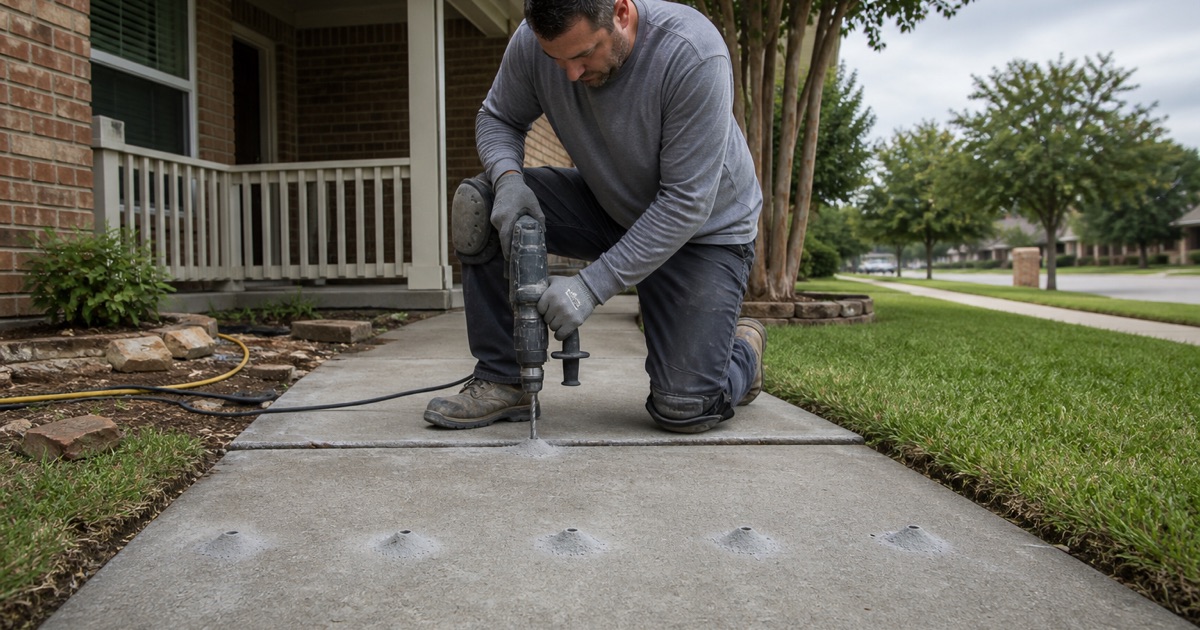
Ports are laid out to reach every mapped void with the fewest holes, and placed where the patches will be least visible once the surface weathers. Drilling is done dry with dust controlled on site, because a harmful quantity of dust from grinding, cutting or sawing is an offense under the city’s stormwater chapter alongside washout itself.
Step 3: Controlled Lift and Monitoring
Material goes in slowly while elevations are watched in real time across the panel and its neighbors. Lifting too fast in one port is what cracks a slab during leveling, so the sequence moves between ports and stops the moment the target elevation is reached rather than when the pump empties.
Step 4: Patch, Seal Joints and Redirect Water
Ports are patched, joints are cleaned and resealed so water stops taking the shortcut back under the slab, and whatever was concentrating water at the edge gets addressed or flagged in writing. Without that last step the void reopens, and the lift you paid for becomes a temporary one.
- 20+ Years in Central Texas
- Bonded & City Registered
- Free Written Estimates