
Temple Elite Concrete pours concrete slabs and pads in Temple, TX, serving surrounding cities including Belton, Nolanville, Harker Heights, Killeen and McGregor, and 20+ years of doing it here has settled one thing: a slab is a structure, not a surface. What it is built on and what will sit on it decide every specification, and both are questions worth answering before a price is discussed. Shop floors, shed and workshop pads, RV and trailer parking, generator and equipment bases, dumpster pads and commercial flatwork are all the same product with very different requirements. A pad carrying a car and a pad carrying a loaded trailer look identical from the street and differ underneath in thickness, base depth, reinforcement and joint layout.
The ground makes that decision sharper here than in most places. Around 41% of the mapped soil under the city is deep smectitic clay that changes volume with moisture, and about 32% is shallow soil over chalk where a trench turns into rock excavation rather than digging. A pad detailed for one and built on the other is a pad that cracks on schedule.
What Goes Under a Concrete Slab
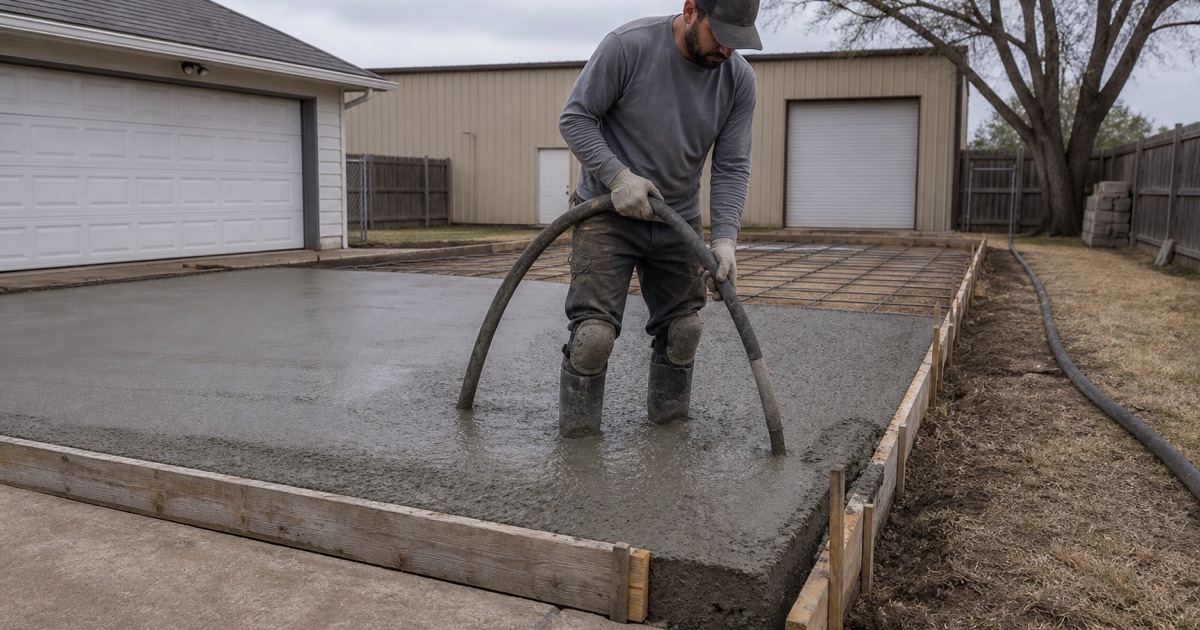
Subgrade Compaction and Base Course
The subgrade is the structural component nobody photographs. Organics and soft material come out, the exposed soil is brought to consistent moisture and density rather than compacted as a dry shell over a soft layer, and a base course is placed where the native ground will not carry the load on its own. Consistency is what we are actually buying. A pad supported firmly at one end and softly at the other will crack at the change no matter how much concrete is above it, so uniform support across the whole footprint is a more useful goal than maximum strength at any one point.
Vapor Barrier and Moisture Control
Any slab that will be enclosed, heated, floored or used to store anything moisture-sensitive gets a vapor barrier under it. Ground moisture moves upward through concrete continuously, and without a barrier it shows up later as damp spots, failed floor coverings, and rust on anything sitting on the surface. Placement details matter as much as the presence of the sheet. Laps get sealed, penetrations get detailed, and the barrier is protected during the pour, because a barrier torn open by a wheelbarrow wheel is a barrier that stopped working before the concrete covered it.
Reinforcement, Thickness and Real Loads
Thickness follows the heaviest concentrated load, not the average one. Welded wire reinforcement or rebar on chairs handles structural loads and soil movement, fiber mesh addresses shrinkage rather than structure, and dowel baskets transfer load across a joint where two sections must move together. We ask for the actual equipment. A hoist column, a press, a loaded trailer tongue jack or a pallet rack leg puts far more stress into a small footprint than a vehicle does, and those points are where a general-purpose slab thickness quietly fails first.
Concrete Slabs and Pads by Use
Shop and Garage Floors
A working shop floor has to take wheel loads, dropped tools, solvents and whatever gets rolled across it, so the surface treatment matters as much as the structure. We detail the falls to a door or a drain rather than leaving a flat plane, since a floor that will be washed down needs somewhere for the water to go. Edge detail deserves the same thought. A shop floor that meets an overhead door needs a thickened edge and a threshold that keeps water out, and a floor that stops at a gravel apron will chip along its edge within a year unless that edge is formed and reinforced for it.
Shed, Workshop and Storage Building Pads
A building pad has to be square, flat and correctly sized for the structure it will carry, because a prefabricated building will not forgive a pad that is out by an inch across a diagonal. We set the pad dimensions from the building manufacturer’s own footprint and detail the edge for how that building anchors down. Anchor placement is the part worth confirming twice. Wall panels and posts are fixed to the pad at set positions, and an anchor that lands on a joint or too near an edge has nothing solid to hold, so we mark those points against the manufacturer’s drawing before the concrete goes down.
RV, Trailer and Equipment Pads
RV and trailer parking is the clearest case of a pad that looks ordinary and is not. Tongue jacks and stabilizer feet concentrate load onto small areas, and a pad sized for a passenger vehicle will spall or crack under them. These pads get extra thickness and reinforcement in the loaded zones rather than a uniform slab everywhere.
Approach matters as well as the pad itself. A trailer has to reach the pad without dragging, so the transition from drive to pad is graded and the pad is sized long enough that the vehicle sits fully on concrete rather than half on dirt that will rut.
Joints, Curing and Finishes
Control, Expansion and Isolation Joints
Concrete will crack, so the joint plan decides where. Control joint spacing commonly runs 24 to 36 times the slab thickness, expansion joints handle thermal movement across long runs, and isolation joints keep a slab from binding against a foundation, a column or an adjacent pour. On a shop floor there is a second consideration. Joints that cross a traffic path will be hit by every wheel that passes, so we place them where they are least exposed and fill them with a material chosen for the traffic rather than left open to spall at the edges.
Placing and Curing Through a Central Texas Summer
Heat compresses the placement window. Once the concrete itself reaches 90 degrees the state highway standard allows 45 minutes from batching to begin discharging, or 75 minutes with a Type B or D admixture, so summer pours are staged and staffed to finish inside that window. Curing is the half that gets skipped. A curing compound or protective cover holds moisture in while the concrete develops strength, and a slab that dries out too fast in its first days ends up with a weaker, dustier surface no sealer will fully rescue.
Floor Finishes and Sealers
Exterior pads get a broom finish for traction. Interior slabs can take a float or steel trowel finish, with a hard trowel producing the dense, smooth surface a shop or garage wants and an open float finish suiting anything that will be coated later. Sealing choice follows use. A penetrating sealer leaves the look unchanged and resists moisture and staining; a film-forming sealer adds sheen and needs renewal, and on a floor that sees solvents or hot tires it is worth knowing which of those the surface can tolerate.
Permits, Grounding and Site Rules
Permits and the Concrete Encased Electrode
Flatwork, driveway and paving permits apply to slab work, applications get 10 business days for city review and comment, and no work may start before the application is approved. Requests for inspection placed after 4:00 p.m. move to the following business day.
Grounding is the detail most often discovered too late. Where an electrician needs a concrete encased electrode, the Ufer ground, it has to be tied into the reinforcement before the pour, and retrofitting it into finished concrete is expensive and ugly. We ask about the electrical scope up front.
Commercial Pads, Dumpster Pads and Truck Courts
Commercial pads take concentrated repeated loads on small areas, which is why dumpster pads and dock aprons are where thin site flatwork fails first. Off-street loading areas must be paved with asphalt or concrete with each berth a minimum of 10 feet by 45 feet, and we thicken and reinforce the loaded zones rather than running one thickness across a site.
Washout, Slurry and Site Runoff
Discharging ready-mixed concrete, mortar, or wastewater from cleaning the equipment used to transport or apply it into the city’s storm sewer is an offense under Code Section 27-43, as is a harmful quantity of dust from sanding, grinding, cutting or sawing. Scale brings a further layer. Site work of one acre or more falls under the city’s small construction activity definition and five acres or more under large construction activity, both tied to Texas Commission on Environmental Quality permitting, which most parking-lot and subdivision flatwork packages cross.
- 20+ Years in Central Texas
- Bonded & City Registered
- Free Written Estimates