
Temple Elite Concrete does decorative concrete in Temple, TX, serving surrounding cities including Belton, Nolanville, Harker Heights, Killeen and McGregor, and 20+ years of it here comes down to a single practical filter: whether a treatment still looks good after several years of hard sun and a ground that moves underneath it. Decorative concrete covers everything done to change how a slab looks rather than what it carries. Some of it happens while the concrete is still plastic, which means the decision has to be made before the truck arrives. Some of it happens to concrete that cured years ago, which means an existing surface can be transformed without demolition.
Those two families behave differently and fail differently, so it is worth knowing which one a given finish belongs to. We walk through both against your actual surfaces, their exposure and what they have to survive, rather than working from a catalog of what photographs well.
Decorative Finishes Placed With the Pour
Integral Color and Dry Shake Hardener
Integral color pigments the whole load, so the color runs full depth and a chipped edge or a saw cut reveals the same shade. It gives the most uniform field and the most durable result, and it carries the highest material cost while limiting how saturated a shade is practical. Dry shake color hardener is broadcast onto the fresh surface and worked in, coloring the top layer while densifying it into a harder wearing surface than the concrete beneath. Used with a contrasting release agent, it produces the shading that makes a decorative slab read as stone rather than as tinted concrete.
Exposed Aggregate, Salt and Broom Textures
Exposed aggregate washes or grinds the surface paste away to reveal the stone in the mix, giving slip resistance without a coating and hiding staining better than a smooth surface. The result depends entirely on the aggregate gradation, so we show you the rock the plant is actually supplying. A salt finish presses rock salt into the fresh surface and washes it out for a fine pitted texture. A broom finish is the workhorse, and varying the direction of the drag or combining it with a smooth border turns the most ordinary finish into a deliberate one.
Sawcut Patterns, Borders and Banding
Every slab needs control joints, so the cheapest decorative move available is deciding where they go. Cutting them into a grid, a diagonal, or a shape that follows the slab means the joints the concrete requires anyway become the design instead of interrupting it. Borders and banding do the same work at the edges. A contrasting band in a different color or texture frames a field, gives an irregular shape a deliberate edge, and provides a natural place for the layout to change direction.
Decorative Treatments for Existing Concrete
Acid Stain, Dye and Antiquing
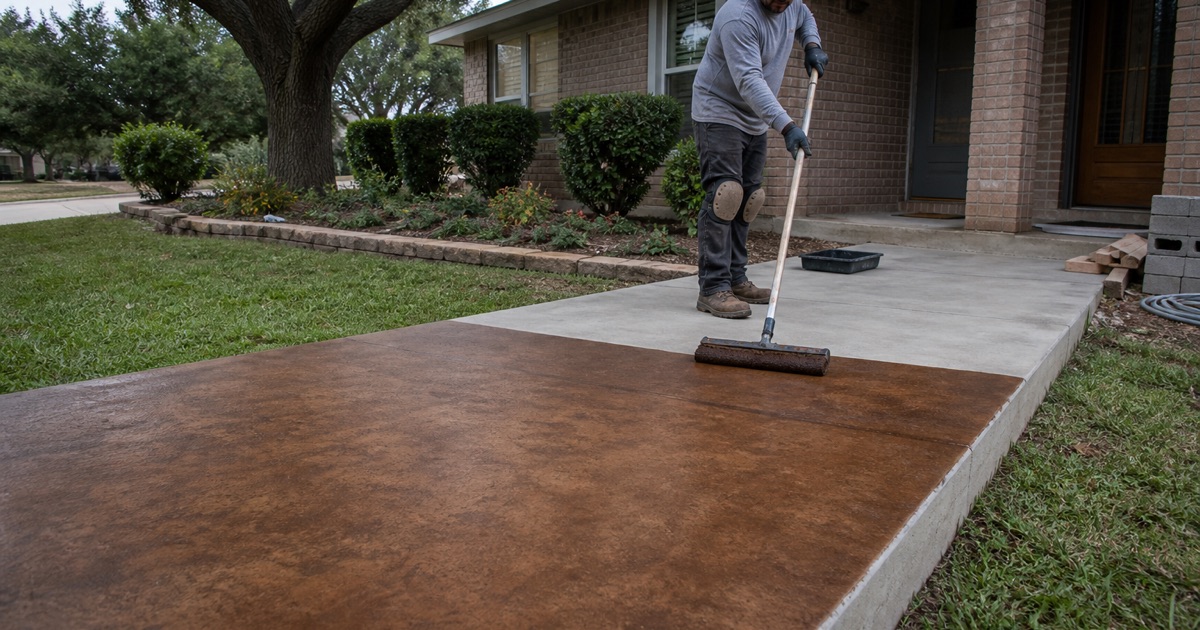
Acid stain reacts chemically with the concrete rather than coating it, producing translucent, variegated color that never looks painted and ages gracefully outdoors. Because it reacts with what is already there, the result varies with the slab, which is part of its appeal and the reason a test area matters. Dye offers a far broader and more vivid range and is the better choice indoors or under cover, since it is less stable in direct sun. On an unshaded slab through a Central Texas summer that difference is the whole decision, and we say which of your surfaces falls where.
Overlays, Microtoppings and Engraving
A microtopping or spray-textured overlay bonds a thin new surface onto sound concrete and takes color and texture like a fresh pour, which is how a worn slab becomes a decorative one without demolition. It is not a fix for a slab that is still moving, because an active crack reads straight through. Engraving cuts a pattern into existing concrete, then colors it, giving a tile or stone appearance on a slab that stays exactly where it is. It suits surfaces where added height at a threshold or door would be a problem.
Polishing and Densified Interior Floors
Mechanically polishing a slab with progressively finer grits and a chemical densifier produces a hard, low-maintenance interior floor with a sheen that comes from the concrete rather than from a coating. It suits shops, retail spaces and garages where a coating would eventually peel. The existing slab decides how good the outcome will be. Aggregate depth, previous patching and the original finish all show in a polished floor, so we look at what is there before promising a result.
Choosing Finishes That Last Here
Sun, Heat and Color Choice
Strong sun fades some color systems faster than others, which is the main reason we push dyes toward covered areas and acid stain or integral color toward open ones. Heat matters separately: a darker slab absorbs more of it, and through a stretch running 101 to 103 degrees an unshaded patio or pool deck is felt directly underfoot.
Sealers, Sheen and Slip Resistance
A penetrating silane or siloxane sealer protects without changing appearance. A film-forming acrylic deepens color, adds sheen and brings a pattern forward, and it is the one requiring periodic renewal. The higher the gloss, the more visible every wear path and scuff becomes.
Slip resistance is a specification, not a hope. A grit additive worked into the sealer restores traction on smooth or high-gloss surfaces, and around pools and on sloped walks we treat it as standard rather than as an option.
Movement, Joints and Repairability
Decorative work sits on concrete that still moves with the ground beneath it, so the joint plan does more for the finished look than any color choice. A crack that follows a sawcut disappears into the design; one that crosses a colored panel does not. Repairability is worth weighing at the outset. Matching color and texture on a weathered decorative surface is genuinely difficult, so where a slab is likely to be disturbed later we favor systems that can be refinished as a whole area rather than patched in one spot.
- 20+ Years in Central Texas
- Bonded & City Registered
- Free Written Estimates